
 By
By Selling a static caravan can seem complicated, particularly if your caravan is located on a holiday park with its own rules regarding sales, transfers and removal. You may be wondering how much your caravan is worth, whether you can sell it privately, what paperwork you need or how quickly you can complete the sale.
The good news is that selling a static caravan can be straightforward when you understand the process and choose the right selling route.
This complete guide explains how to sell a static caravan in the UK, what affects its value, the different ways you can sell, how holiday park rules can affect the transaction and what you can do to make the process easier.
Whether you are upgrading, no longer using your holiday home, facing increasing site fees or simply want to release the value of your caravan, this guide will help you understand your options.
Quick Answer: How Do You Sell a Static Caravan?
The basic process for selling a static caravan usually involves:
- Checking your holiday park agreement and selling rules.
- Establishing the make, model, age and condition of your caravan.
- Obtaining an accurate static caravan valuation.
- Choosing whether to sell privately, through the park or to a professional static caravan buyer.
- Agreeing a price.
- Completing any paperwork or park requirements.
- Receiving payment.
- Arranging ownership transfer or collection where necessary.
The exact process can vary depending on where your caravan is situated and the terms of your holiday park agreement.
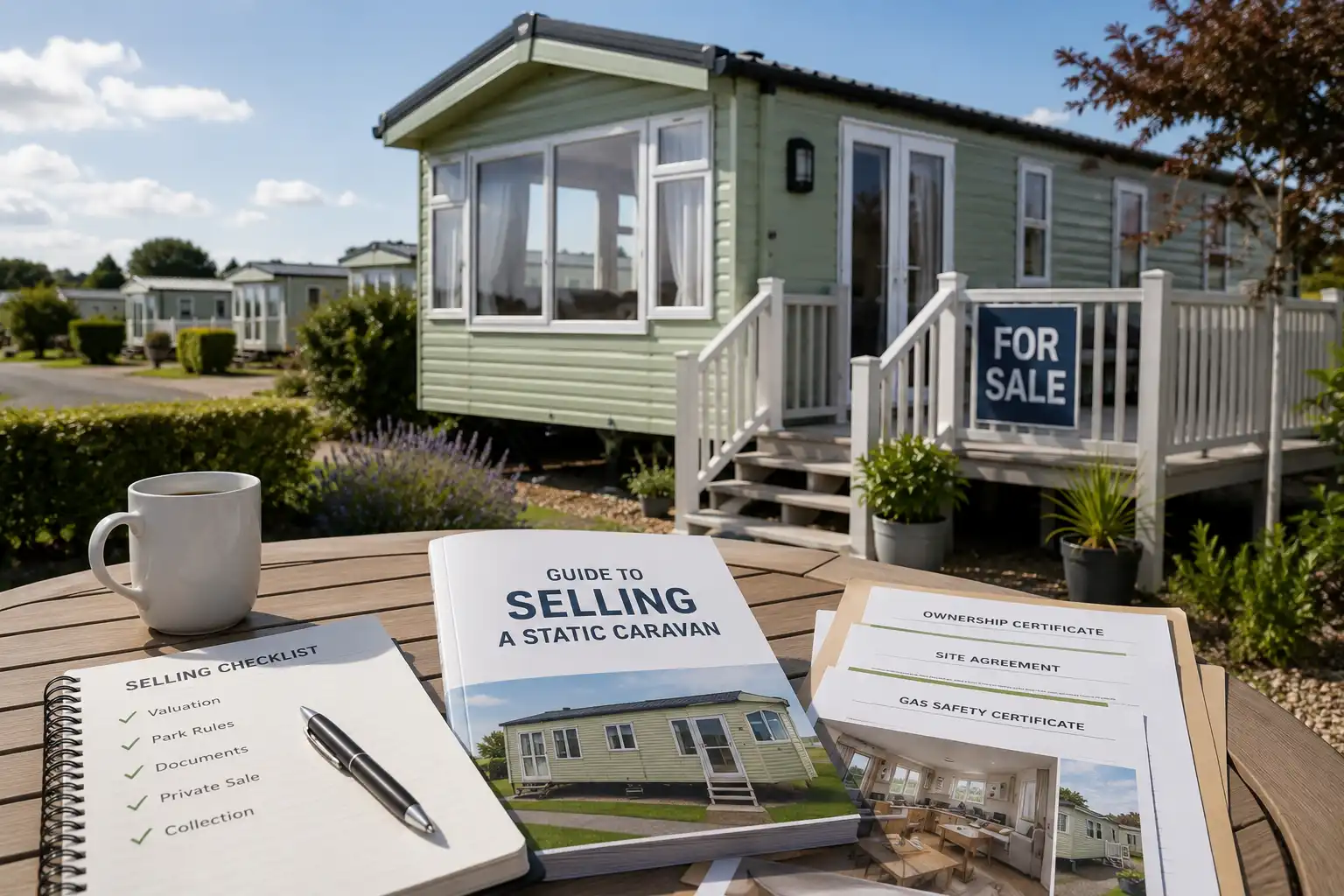
Why Do People Sell Their Static Caravans?
There is no single reason for selling a static caravan.
For many owners, their caravan has provided years of holidays and memorable breaks, but circumstances eventually change.
Common reasons include:
- The caravan is no longer being used regularly
- Annual pitch or site fees have increased
- The owner wants to upgrade to a newer model
- The owner wants to move to another holiday park
- The park licence is approaching its end
- Maintenance is becoming more expensive
- Personal or financial circumstances have changed
- The caravan has become surplus to requirements
Whatever your reason, understanding your caravan’s current market value should usually be one of your first steps.
How Much Is My Static Caravan Worth?
This is understandably one of the first questions owners ask when considering a sale.
There is no standard price that applies to every static caravan. Two caravans of a similar age can have significantly different values depending on their model, condition, location and current demand.
Factors That Affect Static Caravan Value
The main considerations normally include:
Age
Age can have a significant impact on resale value. Newer caravans will generally command higher prices, although age should never be considered in isolation.
An older, well-maintained caravan may still attract considerable interest depending on its make, model and condition.
Make and Model
Well-known manufacturers and popular models can be easier to resell because buyers recognise them and there may be stronger demand.
Providing the exact make and model when requesting a valuation helps a buyer assess your caravan more accurately.
Condition
The overall condition of the caravan is extremely important.
Buyers may consider:
- Exterior condition
- Roof and seals
- Windows and doors
- Signs of damp
- Interior condition
- Flooring
- Kitchen and bathroom condition
- Heating system
- Furniture and fittings
- General maintenance history
Be open about damage or defects when requesting a valuation. Accurate information helps avoid unexpected changes later in the process.
Size and Number of Bedrooms
The length and width of the caravan, number of bedrooms and overall layout can influence demand.
For example, larger family-oriented models may appeal to a different market than compact two-bedroom caravans.
Holiday Park and Location
Where your caravan is located can also affect its value and how it can be sold.
A caravan situated on a popular coastal or countryside holiday park may be viewed differently from one that needs to be transported elsewhere.
However, the value of the caravan itself and the value associated with occupying a particular pitch are not necessarily the same thing.
Remaining Park Licence
Some holiday parks impose age limits or licence periods on caravans. If your caravan has several years remaining on its licence, this may affect its options.
Conversely, if the licence is approaching expiry, removal may need to be considered.
Current Market Demand
Static caravan prices are influenced by supply and demand. Particular makes, models, sizes and ages may be more desirable at different times, which is why obtaining a current valuation is more useful than relying on an old purchase price.
For a more detailed explanation, read our guide to the key factors that determine the value of your static caravan.
Does a Static Caravan Depreciate in Value?
Static caravans will generally depreciate as they become older, although depreciation is not necessarily consistent from year to year.
A caravan’s resale price can be influenced by its original purchase price, age, condition, specification and current market demand.
Owners should therefore avoid assuming that their caravan is worth a particular percentage of what they originally paid. A professional valuation based on the caravan’s present condition and market is usually a better starting point.
What Is the Best Way to Sell a Static Caravan?
There are several ways to sell a static caravan in the UK.
The right option depends on whether your priority is achieving a particular price, selling quickly or minimising the amount of work involved.
Option 1: Sell Your Static Caravan Privately
A private sale means finding the buyer yourself.
This could potentially give you greater control over your asking price, but it also means taking responsibility for the selling process.
You may need to:
- Advertise the caravan
- Take photographs
- Write listings
- Respond to enquiries
- Arrange viewings
- Negotiate with potential buyers
- Verify payment
- Deal with park requirements
- Arrange ownership transfer
You must also establish whether your holiday park permits private sales and whether commissions or other charges apply.
Option 2: Sell Through Your Holiday Park
Some parks provide a resale service or require owners to involve park management when selling.
This can make certain parts of the process easier, particularly when a buyer intends to keep the caravan on its existing pitch.
However, check your agreement carefully.
Find out about:
- Commission
- Administration charges
- Transfer fees
- Selling restrictions
- Age restrictions
- Pitch agreements
- Approval requirements
Understanding these terms before agreeing to sell can prevent surprises.
Option 3: Sell to a Professional Static Caravan Buyer
Another option is to sell directly to an established static caravan buyer.
This route is particularly attractive to owners whose priority is convenience and speed rather than managing advertising and private enquiries themselves.
HD Caravans specialises in buying static caravans and provides a straightforward valuation and selling process.
This can remove much of the work involved with finding and negotiating with individual buyers.
Can I Sell My Static Caravan While It Is on a Holiday Park?
Potentially, yes, but this is an area where owners need to check their individual agreement.
Holiday parks can have their own rules concerning:
- Private sales
- Ownership transfers
- Removal
- Commission
- Pitch licences
- Age restrictions
- New owner approval
Do not assume that selling the caravan automatically transfers the right to occupy its current pitch.
The caravan and the pitch agreement can be separate considerations.
Before agreeing to a sale, read your licence agreement and contact the holiday park if anything is unclear.
Do I Need Permission From the Holiday Park to Sell My Static Caravan?
This depends on your agreement.
Some holiday parks may require owners to notify management before selling, while others may have specific procedures for private sales, transfers or caravan removal.
If a professional buyer will be collecting the caravan, the park may also have requirements concerning access and removal.
Checking these requirements early can prevent unnecessary delays later.
Can a Holiday Park Stop Me Selling My Static Caravan?
Your rights and obligations will depend on the contract or licence agreement you have with the park and the circumstances of the proposed sale.
This is why your agreement should be reviewed before advertising or accepting an offer.
Pay particular attention to clauses relating to:
- Resale
- Commission
- Transfer
- Removal
- Pitch occupation
- Caravan age
- Notice periods
If you are unsure about your contractual rights or obligations, consider obtaining independent professional advice.
What Documents Do I Need to Sell a Static Caravan?
The documents required will depend on your situation, but gathering relevant information before requesting a valuation can speed up the process.
Useful information may include:
- Caravan make
- Caravan model
- Year of manufacture
- Dimensions
- Number of bedrooms
- Holiday park name
- Pitch details
- Licence agreement
- Proof of ownership or purchase documents
- Maintenance information
- Details of modifications or improvements
You may also be asked for clear photographs of the exterior and interior.
Having these details available allows buyers to assess the caravan more efficiently.
How Should I Prepare My Static Caravan for Sale?
You do not necessarily need to undertake a major renovation before selling.
However, presenting the caravan accurately and taking care of straightforward maintenance issues can help buyers assess its condition.
Clean the Interior
Give the caravan a thorough clean, paying attention to:
- Kitchen surfaces
- Bathrooms
- Floors
- Windows
- Upholstery
- Cupboards
- Bedrooms
Removing unnecessary belongings also makes the caravan easier to inspect.
Check for Damp
Damp can significantly affect a caravan’s condition.
Look for:
- Musty smells
- Discoloured walls
- Soft areas
- Mould
- Condensation damage
- Water staining
Do not try to hide significant defects. Honest information is important when obtaining a valuation.
Check the Exterior
Inspect visible areas such as:
- Cladding
- Windows
- Doors
- Roofline
- Guttering
- Seals
- Steps
Make a note of any obvious damage.
Gather Accurate Information
Before contacting a buyer, confirm the caravan’s make, model, year, dimensions and number of bedrooms.
Good-quality photographs can also make the initial valuation process considerably easier.
If the caravan has been unused through the colder months, see our guide on preparing your static caravan for sale after winter.
Should I Repair My Static Caravan Before Selling?
Not necessarily.
Whether repairs make financial sense depends on their cost and the potential impact on the caravan’s value.
Minor jobs such as cleaning, replacing inexpensive damaged items or tidying the exterior may improve presentation.
Large repairs are different.
Spending significant money immediately before selling may not always produce an equivalent increase in value.
If you plan to sell to a professional caravan buyer, it can make sense to request a valuation before paying for substantial repairs.
HD Caravans buys static caravans in a wide range of conditions, so an older or damaged caravan does not necessarily need to be renovated before requesting a quote.
Can I Sell an Old Static Caravan?
Yes, potentially.
Age alone does not necessarily mean a caravan cannot be sold.
Older caravans may still have value depending on:
- Make and model
- Structural condition
- Interior condition
- Size
- Location
- Accessibility
- Current demand
If your caravan is approaching the end of its park licence, obtaining a valuation can help you understand your options before assuming that it has no resale value.
Can I Sell a Damaged Static Caravan?
Potentially, yes.
Damage may reduce the value, but it does not automatically make the caravan unsellable.
Examples include:
- Cosmetic exterior damage
- Worn interiors
- Damaged furniture
- Damp
- Older fixtures
- General wear and tear
When requesting a valuation, provide accurate information and photographs.
This allows the buyer to assess the caravan’s condition realistically.
How Long Does It Take to Sell a Static Caravan?
The timescale depends heavily on how you choose to sell.
A private sale may take longer because you need to find a suitable buyer, arrange viewings and negotiate the transaction.
Selling directly to a specialist buyer can be considerably faster because you do not need to wait for individual buyers to respond to an advertisement.
Holiday park approval and removal requirements can also affect the final timescale.
HD Caravans offers free valuations with offers within 12 hours, helping owners quickly establish whether a direct sale is suitable for them.
What Happens When a Static Caravan Is Collected?
If the caravan is being removed from its current location, collection needs to be coordinated carefully.
A static caravan is significantly different from a touring caravan and usually requires specialist transport.
Factors can include:
- Site access
- Caravan dimensions
- Park permission
- Decking or attachments
- Transport access
- Disconnection requirements
- Collection timing
Never assume that removal will be simple without first checking the site.
HD Caravans offers free collection as part of its buying service, subject to the individual circumstances of the caravan and location.
What Happens to Decking When I Sell My Static Caravan?
This depends on the sale and park arrangements.
Decking may not automatically form part of the caravan sale, particularly if the caravan is being removed from its pitch.
Before accepting an offer, clarify what is included.
The same applies to:
- Steps
- Verandas
- Sheds
- Outdoor furniture
- Storage boxes
- Freestanding appliances
- Other accessories
Clear communication prevents misunderstandings between seller, buyer and park.
What Time of Year Is Best to Sell a Static Caravan?
There is no universal best month to sell because owners’ circumstances and market demand vary.
Spring can generate additional interest as people begin thinking about holidays and the season ahead.
However, professional static caravan buyers operate throughout the year, meaning owners do not necessarily need to wait until spring or summer to request a valuation.
If you have decided to sell because of site fees, licence expiry or changing circumstances, waiting several months purely for the season may not necessarily benefit you.
Selling a Static Caravan Privately vs to a Professional Buyer
The two routes serve different priorities.
Private sale
Potential advantages:
- Greater control over advertising
- Ability to set your own asking price
- Direct negotiation with buyers
Potential disadvantages:
- Advertising required
- Enquiries and viewings
- Potential time-wasters
- Longer selling period
- Payment arrangements
- Park administration
Professional caravan buyer
Potential advantages:
- Faster valuation
- No advertising required
- Fewer enquiries to manage
- Straightforward sale
- Collection may be arranged
- Useful for older or damaged caravans
Potential disadvantage:
- An offer from a trade buyer may differ from the price you hope to achieve through a successful private retail sale.
The right route depends on whether price, speed or convenience is most important to you.
Common Mistakes to Avoid When Selling a Static Caravan
Not Checking Park Rules First
Always understand your park agreement before committing to a sale.
Setting an Unrealistic Price
The amount you originally paid does not determine what the caravan is worth today. Use its present age, condition and market demand to establish a realistic valuation.
Hiding Damage
Being transparent about defects helps prevent problems later.
Spending Too Much on Repairs
Get a valuation before committing significant money to improvements.
Using Poor Photographs
If obtaining an online valuation, clear photographs make it easier for buyers to understand the caravan’s condition.
Forgetting About Collection
If the caravan needs to leave its current pitch, determine who will arrange and pay for removal.
Accepting Payment Without Proper Checks
How to Sell Your Static Caravan with HD Caravans
If you want to avoid advertising, repeated viewings and private negotiations, HD Caravans provides a straightforward alternative.
With more than 35 years of experience in the static caravan industry, HD Caravans buys caravans across the UK in a wide range of ages and conditions.
Step 1: Request a Free Valuation
Complete the online valuation form with information about your static caravan.
Useful details include its make, model, year, dimensions, condition and current location.
Step 2: Receive Your Offer
HD Caravans reviews the information provided and can provide an offer within 12 hours.
Providing accurate details and photographs helps make the valuation process easier.
Step 3: Accept the Offer
If you are happy with the valuation, the next steps can be agreed, including any relevant park requirements.
Step 4: Payment and Collection
Once everything has been agreed, payment and collection can be arranged.
HD Caravans offers instant payment and free collection, helping make the process as straightforward as possible.
Why Choose HD Caravans?
Selling a static caravan can involve several moving parts, particularly when holiday park rules and collection are involved.
Working with an experienced static caravan buyer can simplify the process.
HD Caravans offers:
- Over 35 years of industry experience
- Free static caravan valuations
- Offers within 12 hours
- Instant payment
- Free collection
- Caravans considered in a wide range of conditions
- UK-wide buying service
- Straightforward advice throughout the process
Rather than spending weeks advertising and dealing with enquiries, you can start by finding out what your caravan could be worth.

Frequently Asked Questions About Selling a Static Caravan
Ready to Sell Your Static Caravan?
If you are thinking “I want to sell my static caravan”, the first step is finding out what it could be worth.
HD Caravans provides a simple alternative to advertising privately and managing multiple enquiries. With over 35 years of experience, free valuations, offers within 12 hours, instant payment and free collection, the process is designed to make selling your static caravan as straightforward as possible.
Start your free static caravan valuation today and find out how much your caravan could be worth.
Tags
Static CaravanRecent Posts
Categories

Quick Links
Copyright ©2025. All Rights Reserved. Hugh Daly Caravans | Privacy Policy | Cookie Policy | Sitemap | Areas We Cover